"See far is see in the past" ... and when we look far away, we are able to trace the origins of the universe. It's what NASA astronomers have done by observing, thanks to Hubble Space Telescope, some of the first galaxies formed a little more than 13 billion years ago.
"It was a very ambitious observation campaign, we were able to go back to 13.3 billion years ago, a few million years after the big bang. At that time, the universe was only 3% of its current age", said Richard Ellis, astrophysicist at Caltech, Pasadena.
These observations have been possible, thanks to the team of Richard Ellis, by pushing Hubble to its limits. During six weeks in August and September, they have allowed to discover seven new galaxies which, according to NASA, were born between 400 and 600 millions years after the Big Bang. The oldest, named UDFj-39546284, is 13.3 billion years old, and was formed "only" 390 million years after the Big Bang.
Today, it is estimated that the universe is 13.7 billion years old. And in 2018, the successor of Hubble, the Infrared Space Telescope "James Webb Space Telescope / JWST", will be able to see even further....
Read More …
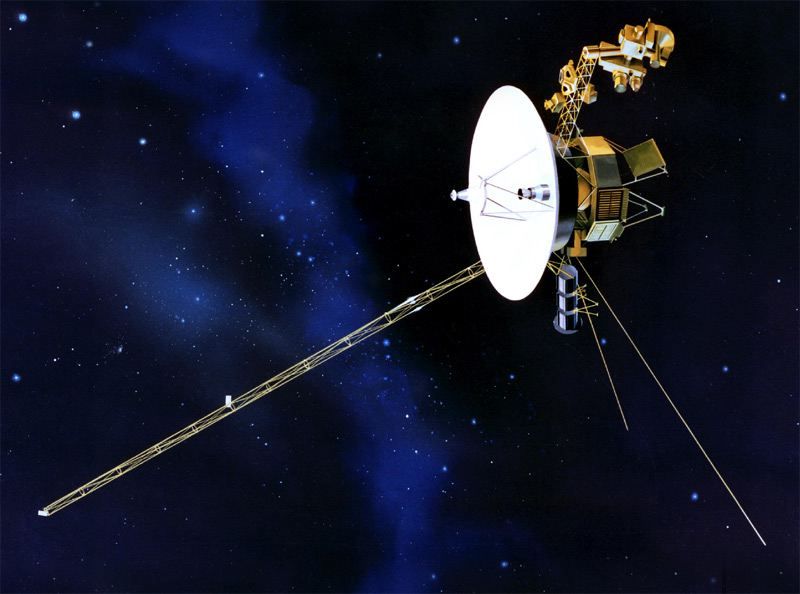
NASA announced Monday, 3 December that the U.S. probe Voyager 1 is currently in the final area before it leaves the solar system. It will become the first vehicle to travel interstellar space.
The probe has traveled many kilometers : 35 years after leaving Earth (in 1977), Voyager 1 is currently, based on board instrumentation, about 18.5 billion kilometers from the Sun, or three times the average distance Sun-Pluto ! For us, as humans, we won't be able to do such a distance. The probe is currently in "Kuiper's cliff" (2nd part of the Kuiper Belt), and probably at the junction between outer space and our solar system.
This area, where Voyager 1 is walking, is like a magnetic highway where the high energy particles from interstellar space enter the solar system. "Although Voyager 1 is still inside the solar environment, we can now see what looks like the outside because the particles enter and leave this magnetic road", said Edward Stone, project manager the at California Institute of Technology (Caltech) in Pasadena.
"If we judge only from the data on the charged particles, I would have thought we were outside the heliosphere. But we need to watch what us tell all the instruments, and only time will tell us if our interpretations about this frontier are correct", said Stamatios Krimigis, working in the Johns Hopkins Applied Physics Laboratory.
The exploration of the solar system the most fruitful ever launched
Thanks to Voyager 1 and Voyager 2 (which has left the Earth one month after Voyager 1), we know our solar system better. The two probes flew by Jupiter, Saturn, Uranus, Neptune and 48 of their moons. The two spacecrafts have in particular revealed a large number of details about the rings of Saturn and discovered those of Jupiter.
They also delivered the first detailed images of the rings of Uranus and Neptune. The two Voyager have also allowed the discovery of 33 new moons and revealed the volcanic activity of Io, well as strange structure in Europa, two moons of Jupiter.
_____________
Source : maxisciences.com
...
Read More …
Categories:
Caltech,
Europa,
Interstellar space,
Io,
Jupiter,
Kuiper Belt,
Moons,
Neptune,
Planets,
Pluto,
Probe,
Saturn,
Solar system,
Space,
Sun,
Uranus,
Voyager 1,
Voyager 2