It's true that the picture you see above is not in high quality. However this real image, taken by the Gemini Planet Imager, shows an exoplanet orbiting around its giant star, at 63 light-years from the Sun.

The exoplanet you see in white is Beta Pictoris b (β Pic b). Discovered in 2008, it has 1.65 times Jupiter's size and between 4 and 11 times its mass. The planet orbits at 1.2-1.3 billion km around its host star (about 2 times bigger than the Sun) in between 17 and 21 years.

The Gemini Planet Imager is actually a high contrast imaging instrument being built for the 8-meter GST (Gemini South Telescope) in Chile, whose development took about a decade. Its goal is to image faint planets next to bright stars, probe their atmospheres and see planet-forming disks around young stars.
To see Beta Pictoris b, astronomers blocked (in the image) the star by a mask so its light doesn’t interfere with the light of the planet. Adding to this, the GPI obtains a spectrum from every pixel element in the field of view to allow scientists to study the planet in detail.

Actually the GPI posted several images, whose one of light scattered by a disk of dust orbiting the star HR 4796 A (one of the two stars of binary star system HR 4796) and an other of Jupiter's moon Europa. For the next years, GPI will study 600 young stars for creating a survey of their orbiting planets, and naturally, the data from the GPI will give infos about planet's formation, atmospheric composition, orbital period and temperature.

Sources : The Verge and Gemini Observatory...
Read More …


Astronomers found the first exoplanet having the same mass as Earth, named KOI-314c. It is the lightest exoplanet ever found, whose the second lightest is Kepler-78b, with 1.7 times Earth's mass.

Located at 200 light-years from the Sun, KOI-314c has a surface temperature of 100°C orbits around its star in only 23 days. Its host star is less massive and cooler than the Sun. The planet has the same mass as Earth's, but is 1.6 times bigger than our planet.

The fact that the orbital period is only 23 days shows that the planet is close to the host star, and so it couldn't contain liquid water, and life. However, according to David Kipping from Harvard-Smithsonian Center for Astrophysics who is the main author of the discover, the exoplanet would have a very thick atmosphere containing hydrogen and helium. The beginning of its life could be the same as Neptune's, then the planet would have lost some of its atmospheric gases over time.

However, Kipping's team of astronomers who participated at HEK Project (Hunt for Exomoons with Kepler) thought that KOI-314c was in the beginning an exomoon orbiting around KOI-314b, an exoplanet having same size as KOI-314c but with 4 times Earth's mass, and orbiting around its host star in only 13 days. The team of astronomers saw then that KOI-314c was finally a planet and not an exomoon.

Sources : Sciences et Avenir (french) and Slate.com

Read also : Exomoon research could start at 1800 light-years from the Sun...
Read More …


A surprise that throws a wrench in planet formation theories : an international team of astronomers in the University of Arizona discovered the most distantly orbiting planet found to date, HD 106906 b, orbiting at ... 654 AU around its star.

We know a few things about this Super-Jupiter. Detected by imaging, HD 106906 b mass is 11 times Jupiter's mass. Its star has approximatively the same size as the Sun but has 1.5 times its mass. Both (planet and star) are only 13 million years old.

Now the problem is how the planet can be so far from its star. 654 AU equals 98 billion kilometers. In our solar system, the distance Sun-Neptune is 30.11 AU (4,5 billion km) and Sun-Pluto 39.48 UA (5.9 billion km). How can the planet be so far of HD 160906 ? The answer is in the moment the star was born, but what is it ?

According to Vanessa Bailey, 5th-year graduate student in the University of Arizona's Department of Astronomy, no model of planet or star formation can explain it completely. However a theory to explain it is about the formation of a binary star system. "A binary star system can be formed when 2 adjacent clumps of gas collapse more or less independently to form stars, and these stars are close enough to each other to exert a mutual gravitation attraction and bind them together in an orbit. It's possible that in the case of the HD 106906 system, star and planet collapsed independently from clumps of gas, but for some reason the planet's progenitor clump was starved for material and never grew large enough to ignite and become a star."
The problem in this stuation is that the mass ratio of the 2 stars in a binary system is normally no more than 10-to-1. And here, the mass ratio is more than 100-1, rejecting the binary system theory.

Other strange thing. You probably think that, because it is so far from the star, HD 106906 b is cold (maybe -100 or -150°C). False. Because the planet is very young, it glows from the residual heat of its formation, and, indeed, the planet is very hot, approximatively 1500°C, but the host star is much hotter. By the way, the planet emits most of its energy as infrared rather than visible light. We could think that the planet is a hot Jupiter, except that it doesn't orbit very close to its star.

We see a new time that discovering new exoplanets with incredible particuliarities leads us to rethink planet formation theories, and to see what universe is able to do.


Source : phys.org...
Read More …


It is a new step for exoplanets discovery. Thanks to Hubble Space Telescope, astronomers managed first to determine the color of a planet outside the solar system. Its name ? HD 189733 b. And the little surprise : this exoplanet is deep blue. You said blue, like Earth ? Yes. But a bit different of blue you can see on a picture of our planet.

Discovered in september 2005 by a team of astronomers from France and Switzerland, HD 189733 b, located at 63 light-years from the Sun, is a gas giant which is 1.26 times Jupiter's size and which orbits around its star (HD 189733, an orange dwarf) in only 2.2 days at a distance of 4.7 million kilometers.

The atmosphere of this planet says a lot : more than 1,000°C (because of its proximity with its star), 7,000 km/h winds. Its composition : water vapor, methane and carbon dioxide. A bit similar to our atmosphere's, but being a gas planet with extreme conditions, HD 189733 b couldn't welcome life.

But the most important is its color. Deep blue. How to find the color of this planet (like any other planet actually) ? Astronomers have observed the exoplanet before, during and after its passage in front of, then behind its star and evaluated each time the quantity and nature of light received, by noting the differences depending on the position. A graph is obtained. 
"We saw the light of the whole system falling in the blue part of the spectrum when the planet passed behind the star. From there, we can understand that the planet is blue, because its signal is constant for the other colors measured", said Tom Evans from Oxford University. (Source : maxisciences.com, french article)
An other question : why is Hd 189733 b blue ? For the moment, the blue of the planet could be because of silicate particles in the atmosphere. Thanks to this method, astronomers hope find the color of other exoplanets (whose more than one thousand are officialy cataloged). With beautiful planet wallpapers that we can find on Google Images, yes, we could find blue, red, yellow, orange, green, purple planets. The thing which will be even more important, will be the first real photos of an exoplanet. Patience !...
Read More …

Categories: , , , ,


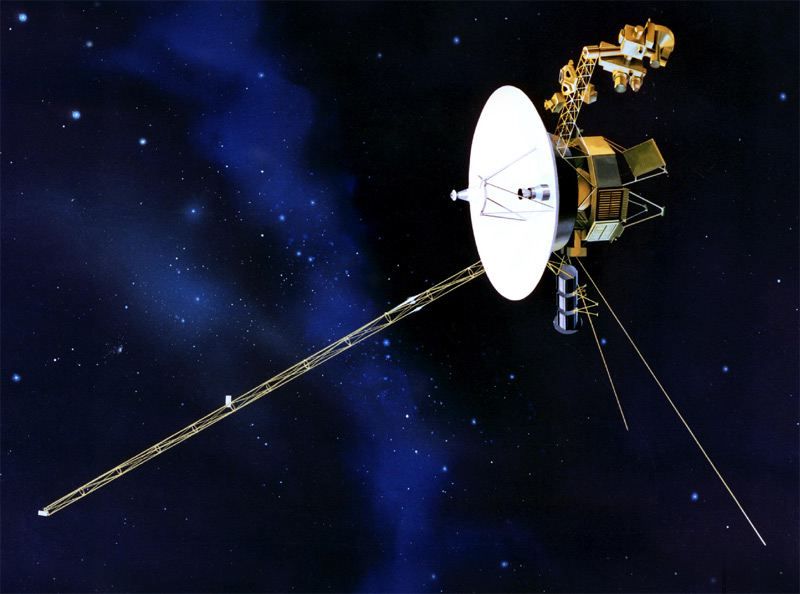
NASA announced Monday, 3 December that the U.S. probe Voyager 1 is currently in the final area before it leaves the solar system. It will become the first vehicle to travel interstellar space.

The probe has traveled many kilometers : 35 years after leaving Earth (in 1977), Voyager 1 is currently, based on board instrumentation, about 18.5 billion kilometers from the Sun, or three times the average distance Sun-Pluto ! For us, as humans, we won't be able to do such a distance. The probe is currently in "Kuiper's cliff" (2nd part of the Kuiper Belt), and probably at the junction between outer space and our solar system.

This area, where Voyager 1 is walking, is like a magnetic highway where the high energy particles from interstellar space enter the solar system. "Although Voyager 1 is still inside the solar environment, we can now see what looks like the outside because the particles enter and leave this magnetic road", said Edward Stone, project manager the at California Institute of Technology (Caltech) in Pasadena.

"If we judge only from the data on the charged particles, I would have thought we were outside the heliosphere. But we need to watch what us tell all the instruments, and only time will tell us if our interpretations about this frontier are correct", said Stamatios Krimigis, working in the Johns Hopkins Applied Physics Laboratory.

The exploration of the solar system the most fruitful ever launched

Thanks to Voyager 1 and Voyager 2 (which has left the Earth one month after Voyager 1), we know our solar system better. The two probes flew by Jupiter, Saturn, Uranus, Neptune and 48 of their moons. The two spacecrafts have in particular revealed a large number of details about the rings of Saturn and discovered those of Jupiter.

They also delivered the first detailed images of the rings of Uranus and Neptune. The two Voyager have also allowed the discovery of 33 new moons and revealed the volcanic activity of Io, well as strange structure in Europa, two moons of Jupiter.


_____________


Source : maxisciences.com 
...
Read More …

Astronomers think they have discovered, with Hobby-Eberly Telescope at Texas's McDonald Observatory the largest black hole ever observed, which has
the mass of about 17 billion times the Sun's.


This monster, whose age is estimated at about 8 billion years, is located at 220 millions light-years from Earth in the spiral galaxy NGC 1277, which is 10 times smaller than the Milky way.

To be honest, the supermassive black hole is very immense : 11 times greater than the orbit of Neptune around the Sun. It is so huge that it represents 14 % of the mass of NGC 1277, against only 0.1% usually. A proportion so high that it could force experts to revise their theories about galaxy formation, they say.

"It is really a unusual galaxy", says Karl Gebhardt of the University of Texas, Austin. "It is almost entirely a black hole. It could constitute the first object of a new class, galactic black holes", says the researcher, co-author of the study published on Wednesday by the British magazine Nature.

First or second biggest black hole ?

We're sure that NGC 1277's black hole is the 2nd biggest black hole found ever, and could be the first. The mass of current number one, discovered only in 2011, has not yet been calculated accurately and oscillates between 6 and 37 billion times Sun's mass.

Black holes create a gravitational field so intense that not even light can escape. A black hole forms when a very large star collapses on itself at the end of his life. It can then continue to grow, swallowing up other stars or fuse with other black holes, which sometimes create these supermassive black holes that occupy the center of galaxies. But NGC 1277's black hole challenges this theory by its disproportionate size compared to its galaxy.

Thus, we ask this question : is this extraordinary black hole unique or is it indicative of a cosmic formation mechanism, and this unknown until now ?
   ...
Read More …


Explore space and stars like you have never though it ! "100.000 Stars" by Chrome Experiment allows you to see the Sun, planets positions, stars (with their infos), and a great vision in 3D of our galaxy, the Milky way. 

You can also click on "play" logo to take a tour from Sun to the galaxy to have a global vision of our stellar neighorhood. To have infos about stars, zoom in until you see the stars and their names, then click on a star.

Go to the "100.000 Stars" animation here ! You need just have a good graphic card and 2 Go RAM Memory to see stars and the galaxy in high quality.

Here are some screenshots of "100.000 Stars" :

The Milky Way Galaxy
Little zoom-in on the Milky Way Galaxy
Some hundreds and thousands of stars
The Sun
 
________________

Source : mashable.com...
Read More …

Categories: , , , ,

Eclipse taken 2 minutes after solar crown
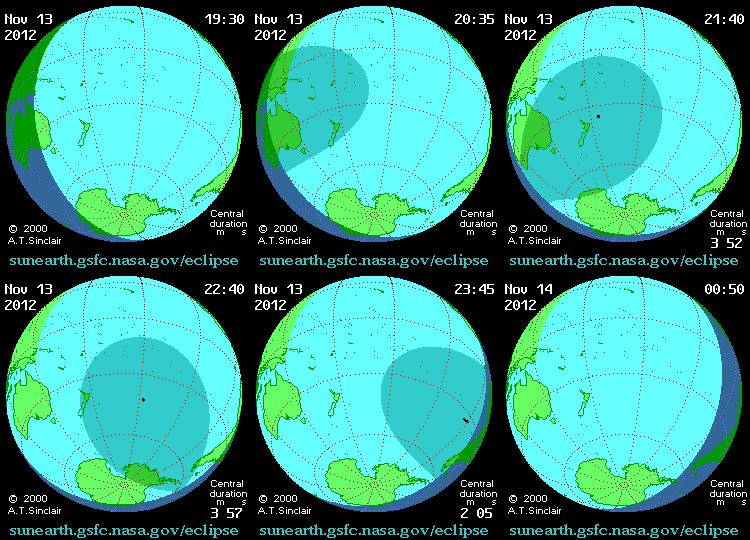
A total solar eclipse has taken place on 13–14 November 2012 (UTC), beginning in local time on November 14 west of the International Date Line over northern Australia, and ending on November 13 east of the date line off the western South American coast. Its greatest magnitude is 1.0500, occurring only 12 hours before perigee, with greatest eclipse totality lasting just over 4 minutes.
In Port Douglas, Australia, the eclipse has been total at 8:45 / 8:50 PM (UTC).

Here's a view of where the eclipse was visible : (more informations here)


Here's some photos of the eclipse (Photo credits Panasonic) :

20 seconds before total eclipse
Totally eclipse : solar crown
View of Port Douglas, Australia - Port Douglas at middle on darkness
Great view of the solar crown

...
Read More …

Categories: , , , ,
____________