It's true that the picture you see above is not in high quality. However this real image, taken by the Gemini Planet Imager, shows an exoplanet orbiting around its giant star, at 63 light-years from the Sun.

The exoplanet you see in white is Beta Pictoris b (β Pic b). Discovered in 2008, it has 1.65 times Jupiter's size and between 4 and 11 times its mass. The planet orbits at 1.2-1.3 billion km around its host star (about 2 times bigger than the Sun) in between 17 and 21 years.

The Gemini Planet Imager is actually a high contrast imaging instrument being built for the 8-meter GST (Gemini South Telescope) in Chile, whose development took about a decade. Its goal is to image faint planets next to bright stars, probe their atmospheres and see planet-forming disks around young stars.
To see Beta Pictoris b, astronomers blocked (in the image) the star by a mask so its light doesn’t interfere with the light of the planet. Adding to this, the GPI obtains a spectrum from every pixel element in the field of view to allow scientists to study the planet in detail.

Actually the GPI posted several images, whose one of light scattered by a disk of dust orbiting the star HR 4796 A (one of the two stars of binary star system HR 4796) and an other of Jupiter's moon Europa. For the next years, GPI will study 600 young stars for creating a survey of their orbiting planets, and naturally, the data from the GPI will give infos about planet's formation, atmospheric composition, orbital period and temperature.

Sources : The Verge and Gemini Observatory...
Read More …


A new proof that we have not discovered everything about our solar system : NASA announced this monday that Hubble discovered a new moon of Neptune. It is actually the smallest moon of the planet.

With a diameter of 19 km, S/2004 N 1 (provisional name of the moon) orbits at a distance of more than 105,000 km from Neptune (between the orbits of Larissa and Proteus) and makes a complete revolution in about 23 hours. According to NASA, the moon shines about 100 million times less than the palest of stars which can be seen to the naked eye.

With its small size, S/2004 N 1 escaped Voyager 2. Indeed, without knowing it, the space probe was near the moon while it studied all Neptune system in 1989. But finally, it's with about 150 photos taken by Hubble of Neptune system between 2004 and 2009 that astronomers found a little white point orbiting around Neptune. The confirmation of the existence of this moon is announced on July 1st by Mark Showalter for SETI Institute in Mountain View (source : maxisciences.com, french post)

The real name of S/2004 N 1 will be announced in the next days or the next weeks by NASA. And maybe, it won't be the last moon that we can find in our solar system. Who knows ?...
Read More …

Eclipse taken 2 minutes after solar crown
A total solar eclipse has taken place on 13–14 November 2012 (UTC), beginning in local time on November 14 west of the International Date Line over northern Australia, and ending on November 13 east of the date line off the western South American coast. Its greatest magnitude is 1.0500, occurring only 12 hours before perigee, with greatest eclipse totality lasting just over 4 minutes.
In Port Douglas, Australia, the eclipse has been total at 8:45 / 8:50 PM (UTC).

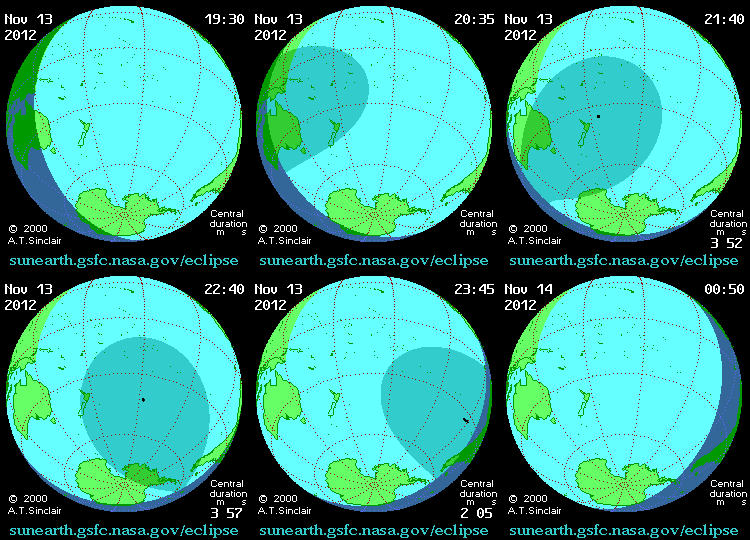
Here's a view of where the eclipse was visible : (more informations here)


Here's some photos of the eclipse (Photo credits Panasonic) :

20 seconds before total eclipse
Totally eclipse : solar crown
View of Port Douglas, Australia - Port Douglas at middle on darkness
Great view of the solar crown

...
Read More …

Categories: , , , ,
____________