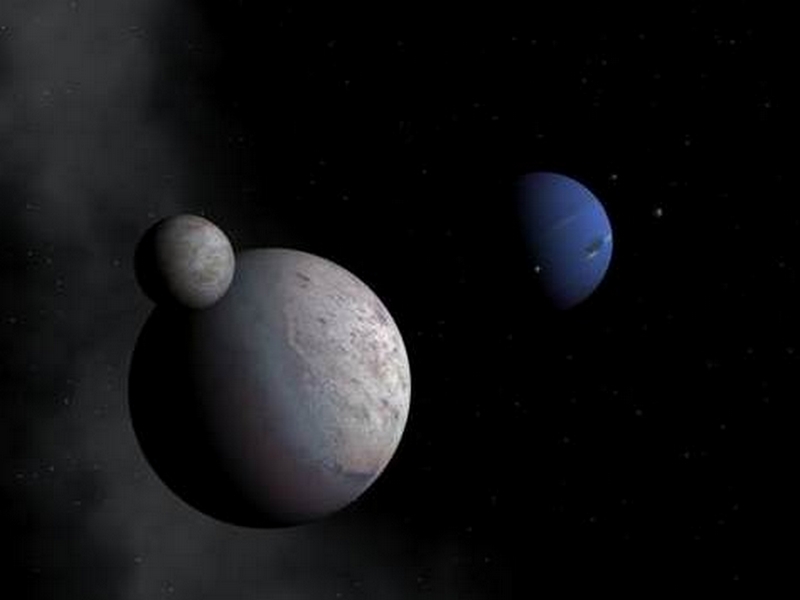
A new proof that we have not discovered everything about our solar system : NASA announced this monday that Hubble discovered a new moon of Neptune. It is actually the smallest moon of the planet.
With a diameter of 19 km, S/2004 N 1 (provisional name of the moon) orbits at a distance of more than 105,000 km from Neptune (between the orbits of Larissa and Proteus) and makes a complete revolution in about 23 hours. According to NASA, the moon shines about 100 million times less than the palest of stars which can be seen to the naked eye.
With its small size, S/2004 N 1 escaped Voyager 2. Indeed, without knowing it, the space probe was near the moon while it studied all Neptune system in 1989. But finally, it's with about 150 photos taken by Hubble of Neptune system between 2004 and 2009 that astronomers found a little white point orbiting around Neptune. The confirmation of the existence of this moon is announced on July 1st by Mark Showalter for SETI Institute in Mountain View (source : maxisciences.com, french post)
The real name of S/2004 N 1 will be announced in the next days or the next weeks by NASA. And maybe, it won't be the last moon that we can find in our solar system. Who knows ?...
Read More …
One of the wonders of the universe is the picture for these Christmas holidays by Hubble Space Telescope : here is the Spiral Planetary Nebula, NGC 5189 (Gum 47, ID 4272).
We know a little bit things about it : discovered in 1826, the symmetrical nebula NGC 5189 is located in the southern small constellation of Musca. At the beginning seen as bright emission, Henize has seen and verified that NGC 5189 is a quasi-planetary nebula. His structure in the picture looks like a giant and bright blue-oranged ribbon.
A few years ago, NASA has estimated it to be 1 780 light-years away from Earth. It has a neighbor, the Hourglass nebula (MyCn18) located at 8,000 years away for Earth and which looks like a hourglass (see MyCn18's picture by HST).
And now, the question is : for Christmas, will we find a nebula which looks like a Christmas ball, a tree, a snowman ? No idea, but space still reserves us many surprises ......
Read More …
"See far is see in the past" ... and when we look far away, we are able to trace the origins of the universe. It's what NASA astronomers have done by observing, thanks to Hubble Space Telescope, some of the first galaxies formed a little more than 13 billion years ago.
"It was a very ambitious observation campaign, we were able to go back to 13.3 billion years ago, a few million years after the big bang. At that time, the universe was only 3% of its current age", said Richard Ellis, astrophysicist at Caltech, Pasadena.
These observations have been possible, thanks to the team of Richard Ellis, by pushing Hubble to its limits. During six weeks in August and September, they have allowed to discover seven new galaxies which, according to NASA, were born between 400 and 600 millions years after the Big Bang. The oldest, named UDFj-39546284, is 13.3 billion years old, and was formed "only" 390 million years after the Big Bang.
Today, it is estimated that the universe is 13.7 billion years old. And in 2018, the successor of Hubble, the Infrared Space Telescope "James Webb Space Telescope / JWST", will be able to see even further....
Read More …